
Author: Moushumi Bhowmik
Costis Drygianakis, Yiorgis Sakellariou
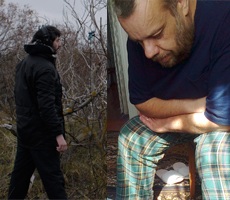
Left: Yiorgis. Right: Costis
The following is a conversation between electroacoustic music composers Costis Drygianakis and Yiorgis Sakellariou, both originating from Greece. Besides their compositional activities, Costis has been researching on and collecting folk music from Russia and other former Soviet republics while Yiorgis has done field work exploring music from Lithuania. His recordings are now part of the World and Traditional music archive of the British Library.
IN SEARCH OF MEANING: REFLECTIONS ON FOLKLORE
The conversation was triggered by a post on the British Library’s blog [1] in which Yiorgis describes his experiences of making recordings in Lithuania. Costis sent him an email with some thoughts which initiated the dialogue. They comment on the notion of tradition, the evolution of folk music and exchange thoughts on their experiences, comparing the current situation of Greek, Russian and Lithuanian music.
Costis Drygianakis:
[…] I would like to underline that the tradition, as we understand it today, was formulated to a great extent in the early 1900’s, mainly because of the development of the ethnographic research and the dissemination of the gramophone record. Up to then, it seems that unaccompanied singing was dominant in everyday life. In Russia, as well as in Greece. Instruments were used rather sparsely, in special cases like weddings or religious feasts. What is probably certain is that, as a part of everyday life activities, singing had none of the characteristics that were imposed on it by scholars and record-producers. For example there was no defined beginning, middle and ending in the songs, as there was no need for it. The lullaby was over when the baby was asleep, the working song when the work was finished. That is why there are similar melodies in different songs, or stand-alone lyrics etc. The concept of a musical “piece” (defined, complete and unique) was grown in Western art music and gradually enforced into folk music. The gramophone record, with its limited available time and its function within a commercial framework that caused the commodification of music, was a primary catalyst in this procedure. If older folk music was a continuum of melodies and lyrics, without defined borders (and defined owners too), then, after the spreading of the gramophone record it became a compendium of separate pieces. It is exactly this procedure that gave birth to the new concepts regarding “tradition”, these ones which became widespread in the post-war world. In Soviet Russia commerce was not as powerful as in the West, but the academic approach of the folklorists already had a decisive role, even from the last years before the 1917 Revolution. In many cases, the actual village music was transformed to a kind of spectacle, starting with researchers like Mitrofan Pyatnitsky. Today it is even more obvious if we consider that this repertoire is performed in “traditional”, old style folk costumes that are not used anywhere else anymore; it makes clear that the concert of this kind of music is something like a museum exhibition.
Yiorgis Sakellariou:
I have been rather troubled regarding the costumes. In a conversation I had with Austė Nakienė [2] she told me that naturally concerts and presentations at festivals have an artistic approach and mentality. She also added that we are essentially looking at a “postcard”, as she said characteristically, an idealized version (for whom, I wonder?). The ensembles are fully aware of that. It is not a matter of authenticity but presenting the work as beautiful and attractive as possible. Besides, the clothes were not so fancy 100 years ago, for example. They were much more simple and practical for work or other activities. Always according to Austė, exceptions were the Sunday mass, weddings and funerals.
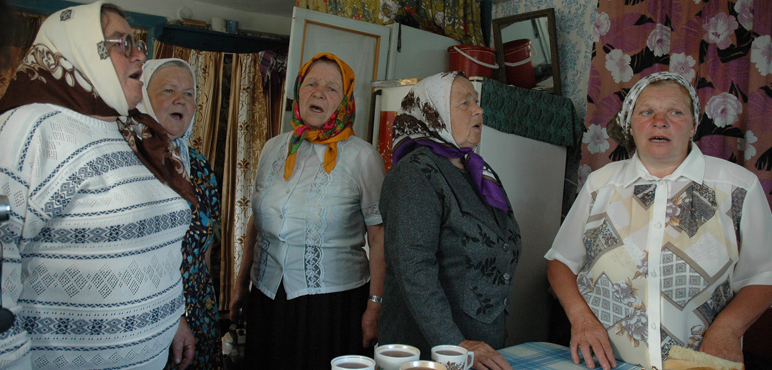 Russia: Sudarushki (“the Ladies”), the folk group of the village of Ilovka, rehearse at home. July 2005.
CD:
They say the same, more or less, in Russia. We are talking about a theatre-type approach that aims to present an idealized past. It is clear that this approach takes place in an urban, modern environment. Here, many of the teachers of the Academy [3] are aware of the changes of the framework but they are unwilling to take a different initiative. This theatrical approach is one of the typical Soviet remains that are still beyond question. I was really shocked in 2010 when I attended some exams of the students in the Academy where all of them performed in “traditional” costumes, although there was no audience besides their fellow students and their teachers.
This framework expands furthermore to the discography. The recording prerequisites in the studio are very specific, as I understood, but there you can see a gradual change of approach.
YS:
My question then would be “Why do we care?” If Russians, Lithuanians, etc. make this aesthetic choice why are we troubled so much? Especially since we do not have the ambition to defend tradition or good taste. Apparently over there they have resolved these issues so let’s just sit back and enjoy it.
CD:
I ’m not against any pleasure or enjoyment but I have two objections. Firstly, I disagree with this forging, or rather misinterpretation of history. Or, to put it milder, I disagree with the creation of public history intended for mass consumption; I find no fun in it. Besides the ideological disagreement, I feel that a lot of problems that we are dealing with in this specific field are caused exactly because of this attempt to invent or to shape traditions.
Secondly, regarding the Academia here in Russia, which I am a bit more familiar with, I don’t think they are enjoying themselves that much, neither themselves nor the people who listen to them. It is a form of compulsion. Of course when the aspect of pleasure is absent, music becomes pointless. Therefore, it is not strange that this repertoire does not have real listeners but only temporal ones (in national commemoration days etc), who attend it being obliged by the circumstances. That is why I am interested in how this music sounded when people still enjoyed it. Or, if we consider that it has not changed (though I am certain that it has), then what is it that has changed so that people do not enjoy it anymore although they used to (and who are these people, and so on). I do not know if in Lithuania the situation is different.
I would also add that this conservatism, as a motivating stimulus, is dangerous. It is not important to restore things as they used to be, but to understand what was then beautiful. If the old beautiful does not correspond with the contemporary one, we have to find out why.
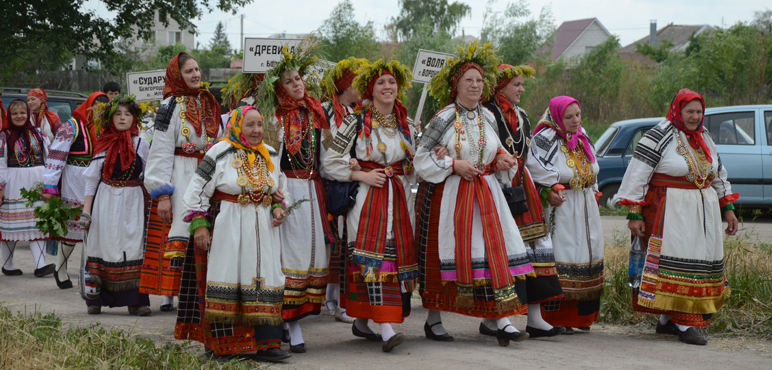 Russia: Volya, Sudarushki and other groups entering the ground of the annual festival of the Holy Trinity in Novaya Usman. June 2011.
YS:
The original truth and purpose of these songs is gone, along with the conditions that gave birth to them. The practical purposes do not exist anymore (work in fields, lullaby etc.) and by default we listen to them out of context. Regardless of the differences in interpretation or orchestration, the changes are much deeper and are dealing with the meaning of both the song and its need to be sung.
I interviewed two young people who are members of the neo-folk/pagan ensemble Kūlgrinda. Out of curiosity I simply asked them why are they doing this; what motivates two youngsters to wear clothes that belong to another era and sing what they consider to be ancient pagan songs? The response from both was that it happened naturally and unforcedly. An initial curiosity was soon transformed into a passion.
However, as I wrote at the British Library blog, despite all the filters this music still has an impact because its original meaning, its reason to exist, was powerful and authentic. Perhaps a lot of people cannot relate or communicate with it but for sure they can understand, or feel, there is a strong meaning behind.
And I should emphasize again how many filters intercede. Changes in social conditions, new ideas and experiences from contemporary practitioners, our cultural distance, the recordings as such. I do not know if, after all, it is I who idealize my experiences. In any case, I share your questioning.
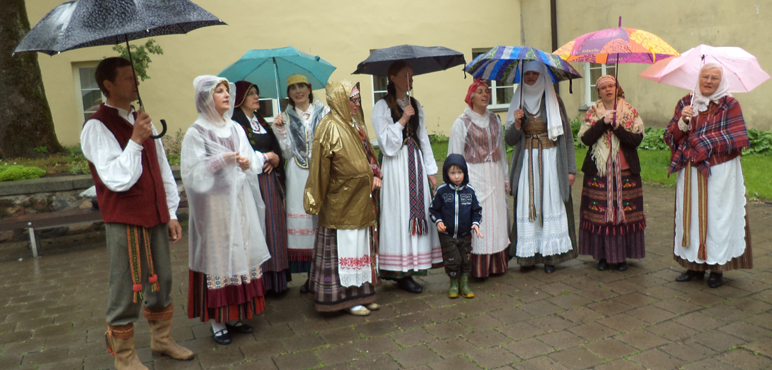 Lithuania: Gadula folk ensemble performing during the event Prašom, svečiai, kieminėt (Please, be my guest) at Vilnius old town. Skamba Skamba Kankliai festival. June 1, 2014.
CD:
You put it correctly. The changes are massive and the new meanings and truths are totally different from the original ones. Even in the course of some years, meanings change.
Neo-pagan ensembles are, I think, another case. There is passion and devotion and somehow it is clear (though I doubt if it always is) that they do not correspond to any historic truth. It is an imagined community, as Anderson puts it [4].
YS:
In many ensembles which participated at Skamba Skamba Kankliai the members are people of old age, especially when the ensembles are not from Vilnius. There was a characteristic concert where Ringailiai, an ensemble from a village near Kaunas performed. In Ringailiai only old people participated and they were joined by members of Tatato, the ensemble of the Ethnomusicology Department of Lithuanian Academy of Music and Theatre, in which almost every member was a female student. I asked if the old people’s motivation is to preserve their traditions. The answer surprised me a bit. Apparently, many things happen for practical and not aesthetic or ideological reasons. Well, these grandmothers and grandfathers participate in the ensembles basically to have a good time. They meet, they socialize, they sing and occasionally they travel to perform in festivals. There are no ideological purposes of preserving tradition or originality.
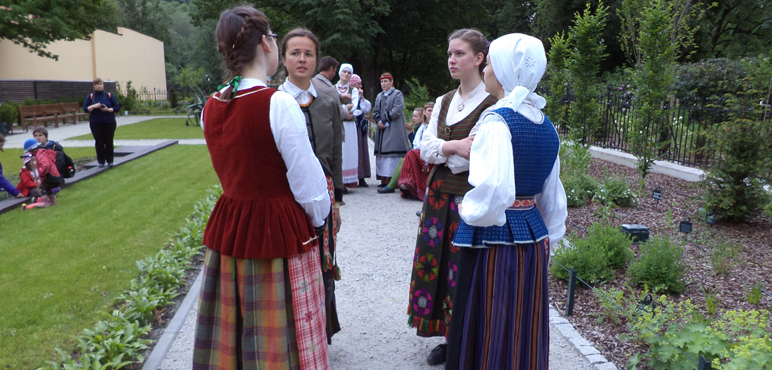 Lithuania: Tatato, the ensemble of the Ethnomusicology Department of Lithuanian Academy of Music of Theatre performing during the event Sutartinių takas (Alley of sutartines) at Bernardinų sode, Vilnius. Skamba Skamba Kankliai festival. May 30, 2014.
CD:
Exactly. They don’t give a damn about tradition. Already the previous generation was educated, went to school, and used to listen to records of the then popular music. Tradition, as opposed to modernity (and therefore set under protection), is an idea that sprung out of the modern urban world. In the villages they have a somehow bitter feeling for the “tradition”, as the difficulties of the old way of life are not yet completely gone.
YS:
When I asked a couple of students if they are interested in an interview I got shyness in response and the occasional distant attitude of Lithuanians. So, I can only guess their motivations. I suppose they do it mechanically, as part of their studies perhaps. Maybe the younger generation feels an obligation to preserve something from the past.
CD:
Yes, I noticed the same thing here, despite the enthusiastic and warm attitude of Russians. I do not think they are very conscious of what they are doing and I am not at all certain that it is their choice to mingle with the “tradition”. Besides, they witness this haggard revival first hand. I don’t know how it is in Lithuania but in Russia it can be even cruel, sometimes.
By the way, Russians make fun of themselves on such topics. There was a very successful song about it in Russia, right after the collapse of the Soviet Union, called American boy; describing the struggle of a Russian teen who plays the balalaika and dreams to go to Jamaica, but there are no babalaikas there, so her knowledge is useless in her struggle to migrate. [5]
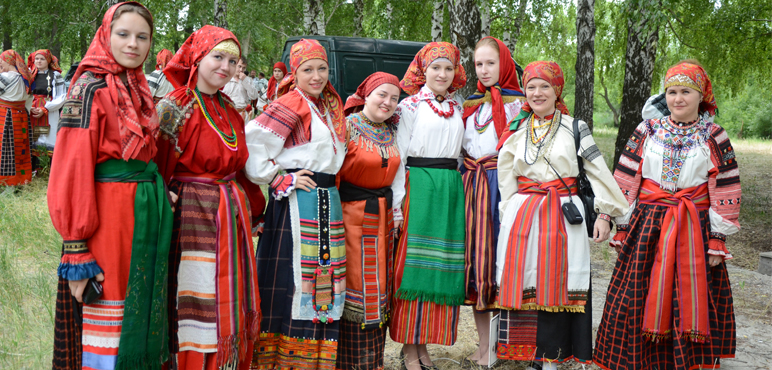 Russia: Terem (“the Room under the roof”), a group of amateurs, all graduates of the Voronezh State University, under the direction of Galina Khristova (second from right), a little after performing at the annual festival of the Holy Trinity in Novaya Usman. June 2011.
YS:
Nonetheless, Austė was rather positive for ensembles that add new elements. She called them post-modern. I have listened some, for example Atalyja [6], who combine rock orchestrations with traditional melodies and moreover it is very important that they add new lyrics on old melodies.
CD:
I agree with her. This is not sterile attachment to the supposed tradition but a new contextualization and thus, I think, a generally healthy procedure. There have been such approaches here too (I think the group Ivan Kupala [7] is one of the most striking examples) but they met the harsh critics of the academic system.
Here I would note that both you and I approached the so-called traditional music with our love for the Other as a basic motivation. I think it is a crucial point which radically differentiates our approach from the approach of the academies. Consider our homeland, Greece; the old traditions were not part of our everyday life when we grew up. The same goes for our life in the countries we later migrated to. In Greece there were records with traditional music, we had some in our house, but this wasn’t in a village. It was in an urban environment, where the “natural” everyday music would be pop or rock and so on. Our searches (in both the so-called contemporary and traditional music) are triggered by our interest of what lies beyond our mundane life, this Other. For the people who live in a village, the relation to what we call tradition is totally different (ranging probably from an unbearable burden to a source of income through tourism).
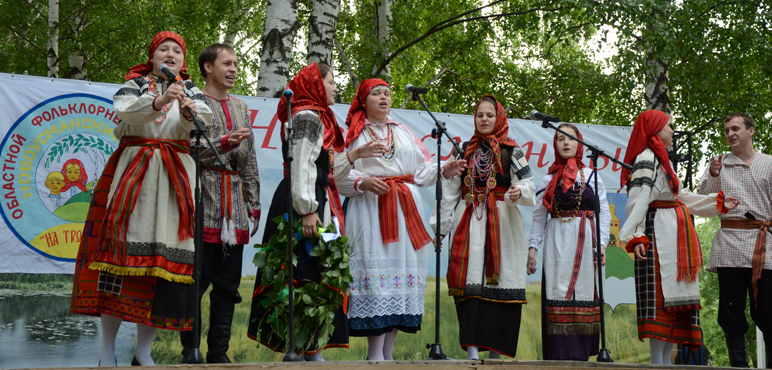 Russia: Volya (“Will, Freedom”), the student group of the Department for Folk Music of the Voronezh State University, under the direction of Galyna Sysoeva (not depicted here) performs at the annual festival of the Holy Trinity in Novaya Usman. June 2011.
YS:
I have additionally the experience of studying traditional Mediterranean music at the conservatory. Of course I had a curiosity for the Other, the more unworldly. That is how the Arabic, or Byzantine if you prefer, scales, the unusual time signatures and the drones were sounding to my ears back then.
My teacher, Nikos Grapsas, lend me a CD with music from Istanbul. On the cover there was a photo of the musicians, one of them was holding a cello. I was surprised as the cello is a Western instrument and I asked him how it got there. “They played anything they could get their hands on”, he replied. “Probably a relative went on a journey and came back with a new instrument. They had absolutely no reason not to use it at once.”
And there is another, perhaps irrelevant story that Austė told me and which I find interesting. The accordion is rather connected to Lithuanian music tradition, especially polka dances. However, around 100 years ago the elders were extremely suspicious of it, in contrary with young musicians. For the elders the “proper” instrument was the bagpipe and the accordion was a stupid box that you just press buttons and music comes out. (Reminds me of the criticism against computer music). The young musicians however liked the loud and clear sound and the fact that the accordion would not get out of tune.
CD:
Your story is not irrelevant, it showcases the dynamic of things. In older days music of this type was open to new elements, basically by obeying practical needs. The obsession with the old (“because this is how things were”) is modern, it is the extreme notion with which the supposed “traditional” musicians clash. Of course this changes from place to place, era to era etc. In previous times, and in most places, the musician (the singer, the lyricist, the painter, every creative person) was part of the intellectual elite, now the “traditional musician” is a kind of remains.
Such questioning has not a lot of appeal in Russia. On the contrary, the idea of reflexivity which became crucial in Western anthropology the last decades, it is rarely touched: “This is how we found it, this is the way we will keep on doing it, until the end of time”. It doesn’t matter so much if they found it already constructed by some previous folklorists. Modern elements that are spring up in the process of research (e.g. structuring songs for recording or concert purpose) are hushed up, consciously or unconsciously, gradually creating a thick layer of “common sense” from which the community of the researchers cannot easily escape from. Questions regarding the methods of ethnography, the identity of the researcher etc, here in Russia are extremely limited and are dealing only with obvious issues, as for example with the injection of pro-state lyrics in the Soviet years. Maybe this is because ethnography in Russia developed as a part of national study and not as a study of foreign cultures, as was the case in the West.
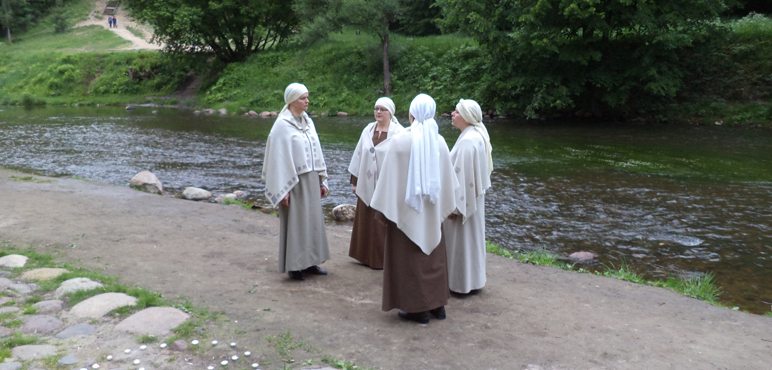 Lithuania: Trys Keturiose performing, under the direction of Daiva Vyčinienė (first on the left), during the event Sutartinių takas (Alley of sutartines) at Bernardinų sode, Vilnius. Skamba Skamba Kankliai festival. May 30, 2014.
YS:
I’d like to express my concern as an ethnographer. By adding my recordings to the British Library archives I have contributed, even a little bit, to the documentation and archiving of Lithuanian music.
What worries me is how inevitably limited my collection is. At least I am consciously aware of that. While I was living in Lithuania I never collected material methodically but more instinctively and based on my taste. No doubt this influenced my recordings and the decisions I made during the Skamba Skamba Kankliai festival. I already knew some participating ensembles, some I did not, some styles I liked (sutartines), some not (polkas). There is also the fact that I collaborated with only one ethnomusicologist. She obviously has very broad knowledge of the subject but she remains only one source of information and undoubtedly she has her own personal taste and opinion. And, of course, Skamba Skamba Kankliai’s program, no matter how diverse, was still fragmented.
Therefore, the fact that this collection is part of the archives of the British Library makes it perhaps overvalued. Maybe I am exaggerating now but I think there is an issue of “authority” as the prestige and status of institutes with reputation, power and resources affect the work to a great degree.
CD:
You are right. I have also thought about this from time to time, although I’ve never had a powerful institute to back me up. Moreover, I completely agree with the observation that the world of music (of Lithuania, of Greece, of Russia or anywhere else) includes the work of everyone involved (village singers, ethnographers, entertainers, pop stars etc.) but no one is above it. No one has the complete knowledge in his head.
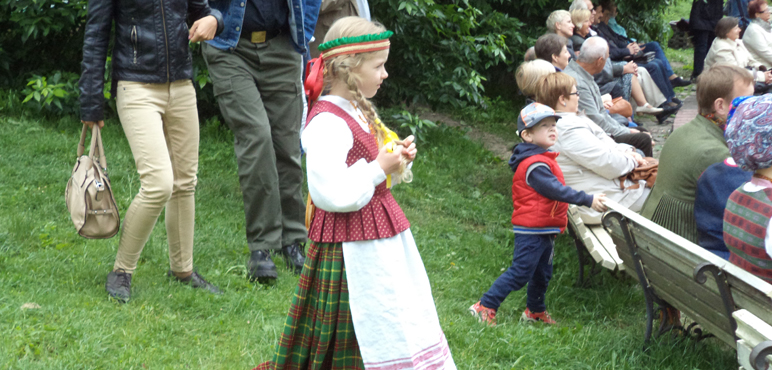 Lithuania: A young participant at Skamba Skamba Kankliai, waiting for her turn to go on stage at Teatro, muzikos ir kino muziejaus kieme (the courtyard of the Lithuanian Theater, Music and Cinema Museum), Vilnius. May 29, 2014.
Notes
1. In the post Sakellariou talks about Skamba Skamba Kankliai, a festival of traditional music that takes place in Lithuania.
http://britishlibrary.typepad.co.uk/sound-and-vision/2014/07/recordings-from-the-skamba-skamba-kankliai-music-festival-lithuania.html
2. Austė Nakienė is an ethnomusicologist working in the Lithuanian Institute of Folklore and Literature (http://www.llti.lt/en/about/). She provided valuable assistance to Yiorgis Sakellariou during the Skamba Skamba Kankliai 2014 recording project.
3. The Academy is the State Academy of the Arts in Voronezh, where there is a faculty of Folk Music, directed by Galina Sysoeva.
4. Anderson Benedict, 2006: Imagined communities: Reflections on the Origin and Spread of Nationalism, Revised Edition. London: Verso
5. American boy by the group Kombinatsiya:
https://www.youtube.com/watch?v=W7hAo28NCXc
6. Atalyja can be heard here:
https://www.youtube.com/watch?v=lbJ4HX90S6U
7. Ivan Kupala can be heard here:
http://www.youtube.com/watch?v=zhNSpilaw0E
Links
● British Library sound archive
http://sounds.bl.uk/
● Skamba Skamba Kankliai festival
http://www.etno.lt/index.php/lt/skamba-skamba-kankliai
● Volya, the folk group of the Voronezh State Arts Academy
http://www.youtube.com/watch?v=Wu9rtV2YomQ
● Costis Drygianakis
http://soundcloud.com/costisdrygianakis
● Yiorgis Sakellariou
http://mechaorga.wordpress.com/
Renee Lulam
Renee Lulam lives in Shillong, a beautiful hill town in the northeast of India. She read comparative literature and has been collecting stories and narratives as an independent researcher and writer since about 2004. Renee is interested in how stories and narratives are used to connect with people and for healing, especially among small communities in the northeast of India. With Julius Basaiawmoit, Renee won a fellowship from Sarai-CSDS in 2007 to research and document the changing face of democratic spaces in urban cosmopolitan Shillong. Before that she was a Majlis Cultural Fellow, researching and collecting narratives of women from her region. Renee occasionally presents talks on the North Eastern Services of All India Radio.
renee75@gmail.com

STORIES AS SONGS: ORAL TRADITIONS IN THE KHASI HILLS
The year was 2008. I was collecting stories and narratives around the Khasi practice of erecting monoliths as markers to commemorate events, researching how these are an archive of memories for the community. The research was to turn into a documentary based on the stones around Mawrong and Raid Narlein in Ri Bhoi District of Meghalaya. I was co-director to Julius Basaiawmoit, who was also Sound Recordist and Sound Designer for the film. In the post production stages of the film, Chosterfield Khongwir agreed to join us as Music Director. Referred to as Babu Chos, an appellation of reverence, I was told to call him ‘Ma’, a more familiar term of respect reserved for closer associations.
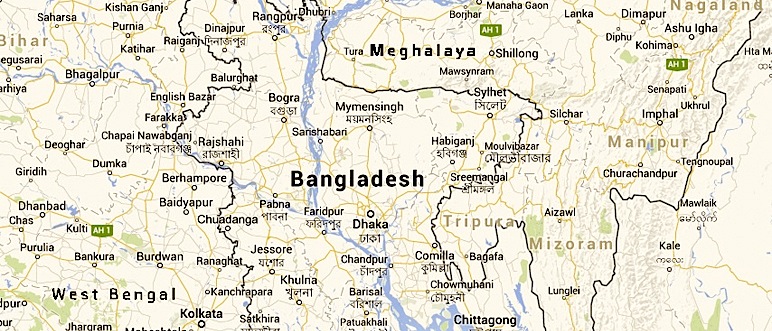 Shillong, a beautiful hill town in the northeast of India
Having grown up in Shillong, where for the longest time, All India Radio was the only source of music to many in this small hill town, Ma Chos’s name was not particularly new to me. AIR was where local artists aspired to perform, and where we listened to them. AIR’s mixed bag of artists included other local folk artists like Beriwell Kyndiah, Skendrowell Syiemlieh, Brektis Wanswett, Helen Giri, Lumtimai Syiemlieh on one side; and names like Headingson Ryntathiang, Phom Lyttan, The Fentones, Therisia War, The Vanguards and others who wrote, performed and sang in popular Western music genres on the other.
Chosterfield Khongwir is a noted composer, musician and ethnomusicologist; he was also a senior lecturer with the Khasi Department in St. Edmund’s College, a premier institute in Shillong from where he retired. He grew up in Umsning, Ri Bhoi district, forty-five minutes from Shillong, ‘A melting pot of Khasi culture . . . Khasis from everywhere, all districts live there.’ As we discussed narratives the stones yielded, Ma Chos would break in, sometimes to explain a reference or to clear some confusion, but mostly to hum a tune that traditionally would accompany a particular narrative. ‘You see, in Raid Narlein this song is sung this way,’ he said, breaking into a little tune. ‘Five kilometers from there, they sing the same song like this,’ and inserted a subtle slur to the tune that my untrained ear would have missed had he not pointed it out.
‘These slurs are only learnt by the ear,’ Meban had told me some weeks ago, on a hot spring afternoon in 2014, in Martin Luther Christian University’s Department of Music. Mebanlamphang Lyngdoh is another practitioner, a composer who also plays a variety of indigenous musical instruments. ‘These aspects of Khasi music cannot be put into staff notation; they have to be learnt by ear, transmitted orally.’ What about Tonic Sol-fa? ‘The Khasi music scale cannot be adequately rendered into tonic sol-fa either.’ In his thirties, he has been involved with several cultural organizations, and teaches in MLCU. Before this, he taught in the Music Department of St. Anthony’s College. Both institutes are in Shillong. He invited me to a programme at St. Mary’s School, ‘The HTCWO will hold a programme there. It is a part of the organisation’s efforts to sow an interest in traditional music in young minds.’ I wanted to know how they did that. ‘We carry instruments; we play them, we sing songs and tell stories about the songs, about the instruments. You can also meet Bah (another term of respect for men) Teibor, the president.’
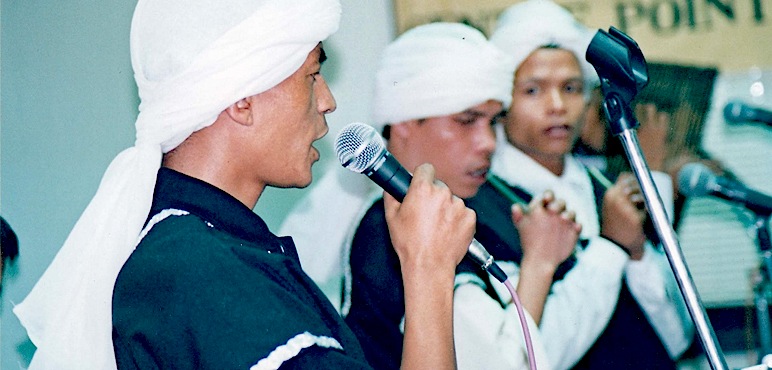 Introductions. Pynter Orchestra
The first time I encountered HTCWO (Hynniew Trep Cultural Welfare Organisation) was at the one-off 1st North-East Documentary Film Festival, way back in 2005. As a side show, festival organizers (the now defunct Institute of Environmental Management and Social Development) arranged for an orchestra to play local tunes on folk instruments to entertain the guests at lunch. Pynter Orchestra from Pynnursla, a little over an hour’s drive further uphill from Shillong, was associated with HTCWO. The orchestra has come a long way since, and remains connected with HTCWO.
I was late and the programme had already begun when I got to St. Mary’s School. Performers onstage were dressed in a combination of traditional clothing and casual wear. Meban was on the duitara, a stringed instrument, while Melinda Kharsati was at the mic. Around them were other musicians on their instruments – another duitara, the bom (a kind of floor drum with a bassish timbre), two or three ksing(drums), and more percussion instruments. In the corner lay more instruments, more strings and some wind.
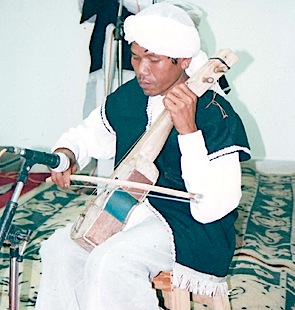
Pynter Orchestra. The instrument is called Maryngud
I understood better what Meban meant by telling stories. Their interaction with the students had a certain story-telling aspect to it, as suggestions and information imparted were turned into narratives. I couldn’t tell if this was deliberate, a conscious effort; if there was a specific methodology behind it. I had only witnessed such levels of interaction before in more informal settings and smaller groups. When I asked Meban about it later, he gave me a look both befuddled and pleased. I realized it was not contrived, that it was a practice they were not even conscious of. I found that immensely pleasing too.
Segueing easily from Khasi to English and back to Khasi, the afternoon’s programme consisted much of songs, old and new. Songs I grew up hearing on the radio, and songs from contemporary practitioners; stories behind the songs, and always an acknowledgement of the song’s composer. The song that Melinda performed as I arrived was a Meban composition. A green banner above the stage announced the organisation’s motto: Lada ia ki rukom bad dustur la jong ia klet bad jah, ning ap sa tang ia ka por ban jah ka jaidbynriew. (If tradition and culture are forgotten and lost, it will only be a question of time that a race or nation will disappear.)
Bah Teibor was a small dignified man, with neat salt and pepper hair and sharp-eyes. ‘We need to reawaken in our youth an interest in our own art and culture. It is only when we are rooted and understand our own that we can appreciate and respect other cultures.’ He said. ‘We do not discourage them from practicing certain things from other cultures. But even if they do, if they are clear about their own, they will never be shaken. We will not lose who we are.’ Onstage, Timmy Kharhujon brought out his guitar to sing a song he composed about forgotten values, fatherless children and environmental degradation. Bah Teibor explained, ‘The first thing for Khasis is nature. It is God’s gift. We are all created by God to live together. Without Mother Nature, we will not survive.’
Survival, the anxiety of being swamped out, is a constant subtext in any conversation on Khasi culture. I asked him if he believed that the Khasi culture of fifty years ago was the same as that of a hundred years ago. ‘No, of course not. We adapted to the changes, but we knew who we were.’
It is likely that this anxiety stemmed from the time of the missionaries. Those who converted were encouraged to renounce their ‘old ways’ which were disregarded as ‘pagan customs’ that were ‘backward’, and for the longest time, Khasi traditional music was rendered almost invisible. During the two World Wars, these hills were recuperation centers for hundreds of soldiers fighting on the Eastern Front. During the Second World War, Shillong became an R&R Camp for British and American troops fighting in the Burmese War. With rest and relaxation came entertainment, and Western music was naturally the main scene. There were parties, sing-a-longs, stage performances; western music was central to all these. A whole generation grew up on this culture where Khasi music took a back seat. Today, it isn’t just ‘Western culture’ that they are anxious about, but Bollywood culture as well. ‘Now, things are different because the kind of mixing that goes on now is different from the kind before.’ Bah Teibor continues. ‘Now also we must adapt. But we must be clear about our own so that we do not lose ourselves.’
Timmy is the vocalist of Snow White, a folk-influenced rock band which draws on local mythology in their lyrics, and sings in Khasi. Rangdajied – which can be literally translated to mean ‘the chosen one’, though it means much more in context, and highly symbolic in Khasi culture and mythology – was the title of their first album released around 2005, which in many ways remains seminal to this day. Recently, they discovered that a local commercial concern used one of the numbers in the album as a theme-song for one of their businesses without informing the band. ‘Talent and hard work are still not respected, what can I say?’ Timmy lamented. ‘We put so much into that album, that song. Especially Don (Lead-guitarist of the band and composer of the song). With just one click of a button, all that hard work is used for commercial gain. We would have preferred if it was a band performing the song without asking us.’ I remembered Pynter Orchestra at the film festival. There was little I could say; such undervaluing of artists and practitioners was discouraging. I had hoped things had improved.
Folk musicians still struggle for acknowledgement in the mainstream, but practitioners like Bah Kerios Wahlang have made headway after years of struggle, garnering modest recognition for his music. An accomplished musician and artisan from Mawngap village, he is an extraordinary presence at folk festivals across the country. Another presence is the much younger and lesser known Kong Battimai Kurkalang of Laitkyrhong village who took her music to the World Social Forum in Mumbai in 2004.
After the programme Meban was to head towards Lakreh School, where the Jeebon Roy Academy of Creative Arts conducted music classes in the evenings. ‘There are many institutes that teach our music,’ he said. ‘And there are also many who are learning. Even non-Khasis. Times have changed.’ Change was slow, not always visible, but it was there. ‘Previously, when you said Khasi folk music, people thought it was music practiced only by those of the indigenous religion. But now that has changed – anyone can be interested in folk music,’ Ma Chos had said years ago.
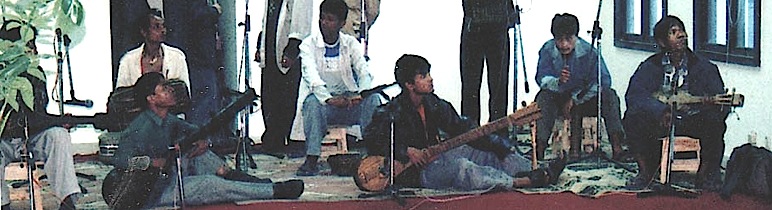 The orchestra preparing for a performance. The instruments that resemble the sitar are called the Marynthing.
Schools like KJP Synod and Pearly Dew include folk music as an important extra-curricular activity. Pearly Dew Secondary School is situated in the middle of an otherwise residential locality of Jaiaw Laitdom. The school’s founder and Principal Ibarilin Kharsati started the school as a response to rising poverty and number of drop-outs in the community. The school has successively yielded better results at the State Board examinations. The Headmaster’s office is housed in an old Assam-type construction. It is large and airy with clean white-washed walls and black wooden panels. Musical instruments like the ksing, the duitara, and some guitars lie in various corners and on shelves. On informing the office-staff, students are allowed to take any of the instruments out of the office, to be returned before the school-day ends. Various members of Summersalt, a gospel-influenced band, who include traditional instruments in their music, went to this school. The band features a number of innovations in their repertoire, experimenting with common items found around a Khasi household, like brooms and baskets as instruments.
One street down from Pearly Dew School is the home of Lumtimai Syiemlieh. Kong Lum (‘Kong’ is a term of respect reserved for women) has been an All India Radio artist since her youth, and the youngest daughter of Kong Listrimai Syiemlieh, arguably one of the most prolific of Khasi composers, and foremost among the women. I had gone to meet her in the summer of 2007. She lived in one of those old Shillong houses: small, neat Assam-type with a corrugated tin roof and rain gutters. The garden in her front yard was a burst of cheerful colours.
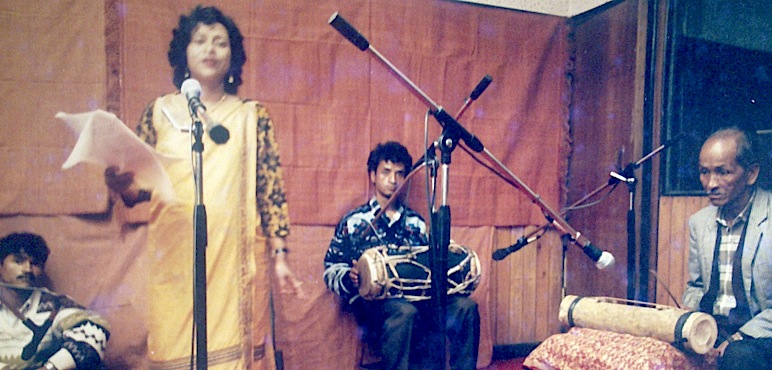 A young Kong Lum performing.
Kong Lum comes bustling to the door. She has a ready smile and a girlish giggle. Everything about her draws one in. In Khasi matrilineal practice, being the youngest daughter makes Kong Lum primary custodian of the family’s heritage. She takes this seriously. ‘We are five brothers and three sisters, and most of us used to sing. Four of my brothers have passed on. My mother composed songs and arranged them. She taught us about singing and music,’ she said, offering me some kwai (areca-nut with betel leaf and a dab of lime) from the shang kwai – a basket where the makings of kwai are kept. Usually, each Khasi household has one of these. ‘My children are also blessed to have spent their formative years under her guidance. They were both already performing at All India Radio at three, four years of age. After she passed away, I continued to teach them music. They should know how to sing their grandmother’s compositions.’ Kong Listrimai composed songs about Khasi life, Khasi values, the Khasi worldview. ‘But my favourite are the ones about the love of a mother, a mother’s heart,’ she continued, ‘a mother’s love is the hearth of the family ‘rympei’; it is the source of life, warmth, and wealth of a family. I don’t mean “money” wealth.’
This symbolism of the hearth as a mother’s heart is aptly illustrated in the lyrics of ‘Rympei Baieit i Mei’, roughly translated to mean ‘Beloved Hearth of Mother’. The hearth represents nurture, value, instruction and wise counsel. ‘Even courtships took place around the hearth, under the watchful eye of the mother,’ Kong Lum explained. The song’s opening lines Rympei baieit i mei/Ba sngewhun ha ka pyrthei/ La duk la thngan te lei/Ba don ha jan i mei/tang jynhaw jong i la biang, talk about the power of a mother’s love to bring contentment to her children’s world, poverty has no place close to a mother’s hearth. The mere sound of her voice is enough reminder of one’s wealth. Another verse goes Rympei baieit i mei/ba sngewshain ha ka pyrthei/khyllait na ieing I mei/ngan iaid sawdong pyrthei/tip kan long kumno ia nga?, declares it is at the mother’s hearth that faith in one’s self is formed. One could leave the home and travel the world, but the question is what would happen without the hearth – the faith in one’s self to leave the home and travel the world would not be, if not for the hearth. It also is a call to never forget all that was imparted at the hearth.
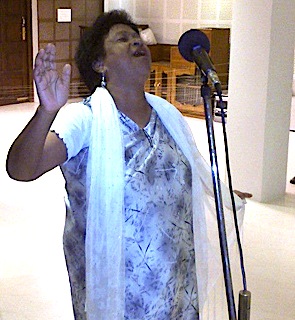
Kong Lum testing the acoustics of a studio!
‘My favourite are the songs where she talks about love between a man and a woman. Romantic love,’ Kong Cass pitched in. Kong Cassandra Syiemlieh is Kong Listrimai’s second daughter and Komg Lum’s elder sister, who dropped in earlier to visit her sister. ‘You see, in our matrilineal system, it is very important to understand this relationship. If we don’t understand it, we will not understand the responsibility of men. These days, only few men grasp the importance of their position in our society. Many young boys don’t even know,’ she said. Kong Cass retired as Senior Lecturer of English from St. Edmund’s College. She did her MPhil research on Bob Dylan. Their eldest sister who also used to sing, Kong Loissimai Syiemlieh, was out of town, visiting relatives in Mairang, West Khasi Hills district, where Kong Listrimai was originally from.
Kong Lum’s sons both sing and play various instruments. ‘But Arbanjop, my younger son prefers playing instruments to singing. He opted to study for a Bachelor of Music degree. He also paints. Lamphang, the older one loves singing. I have trained him in traditional Khasi and folk; he has also learnt jazz from Pauline (Warjri – voice artist, musician and director of Aroha Choir), and now he sings both,’ she said with pride when I met her at a concert early last year.
Indeed, Lamphang Syiemlieh has made something of a name for himself as a growing artist whose range and style are inimitable. When I met him this February, Lamphang himself said, ‘I love jazz and I will continue to sing it, but I will always sing Khasi traditional. Especially my grandmother’s songs. How can I forget what she and my mother taught me? That’s my heritage.’ Like Meban had said, there are some things about traditional music that can only be transmitted and taught orally.
What advantage do the music schools offer, then? Schools like Dr. Helen Giri’s La Riti Academy, Snap Paka Institute and others enroll a number of students, but how does formal learning benefit them the way oral learning does not? ‘A theoretical learning of music; they learn how to read notes, and once they understand theory, they have a strong foundation in their art,’ said Meban, as he and the others packed-up their instruments at the end of the programme. Doesn’t rendering folk songs into notes interfere with the innovative spirit of folk traditions, I asked. ‘What they are taught is to read music and the basic tune of a song. We encourage all our students to express themselves through the songs, to be creative with them. They are encouraged to innovate. And as I already said, there are still things that can only be learnt by the ear.’
I could understand that. Community life isn’t what it used to be, and these arts that were once taken for granted can no longer be; oral practices also have to adapt. ‘One thing you must not forget, culture is dynamic.’ Ma Chos had said, ‘it has to be dynamic for us to grow and survive; if culture is no more dynamic, we cannot adapt. That is very dangerous for our survival.’
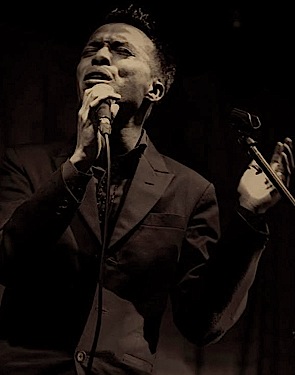
Lamphang Syiemlieh
‘We have to innovate even with our instruments,’ Meban continued on the topic. ‘With the duitara, while you see wooden pegs in front, we use tuning keys from the guitar behind. We have to; with wood, it soon becomes useless – wood shrinks when it dries, and that loosens it.’ I wondered aloud how that was avoided in olden times. ‘I think it is because in olden days, the duitara was used only in one place, around the hearth. They would leave it near the hearth, and they played it near the hearth – maybe two, three songs. See, performance itself has changed and evolved. Now we have to play ten songs before a large audience in a hall. The instruments also have to be made to last through these rigours,’ he responded.
‘Performance taken out of the home and communities has helped us to understand our music better. The same song will sound different sung by someone from West Khasi Hills than from East Khasi Hills or Ri Bhoi. The tune would be the same, but it will sound different. You know, we wouldn’t have understood these things if performance hadn’t been taken out of the home to large audiences,’ Kong Lum said recently, as we chatted over red tea in her little kitchen. As she said this, I realized how similar yet vastly different Kerios Wahlang and Chosterfield Khongwir’s styles are. While roughly of the same generation, both singing in Khasi folk genres, to me the music of Ma Chos evokes an undulating landscape, gentle green slopes, and low-lying paddy fields, while Bah Kerios conjures a slightly more rugged landscape, waterfalls, vegetable plantations on hillsides, and cold mornings.
The programme wrapped up, Meban and I walked towards his car. He was already late for his next class, and I didn’t want to delay him further. He had been patient and gracious with my questions, as had Bah Teibor. It had been a lovely afternoon, and I learned much. I thanked them as they got into the car. They would have to drive downhill on Bomfyle Road, then up past the Governor’s House, and cut across the always crowded Police Bazaar before they reached Umsohsun, where Lakreh School was.
As I crossed Laitumkhrah’s busy traffic laden Main Road on foot, heading downhill towards the more residential part of the locality, where I live, I suddenly longed to hear Ma Chos’ voice. It had been far too long. I dialed his number from my cell-phone. He told me how occupied he was, that after retirement he was even busier. He sounded content. ‘I have also started a music school in Umsning. It’s good that you called and now we are reconnected. We’ll meet; I will call you when I come to Laitumkhrah. I must go now,’ he ended.
I smiled, happy to hear he was even more immersed in music in retirement. I look forward to the call.
Renee Lulam
Shillong
27th April 2014
Here are two songs by Chosterfield Khongwir. Both songs were recorded and mixed by Julius Basaiawmoit for Renee and Julius’ film Ki Sakhi Ka Mynnor.
Related Links
Lamphang singing a song composed by his grandmother : https://soundcloud.com/lamphang-syiemlieh/iam-meikha-from-the-album
Aroha at the Healing Histories conference, Caux, Switzerland: https://www.youtube.com/watch?v=0_VmFlnLrkk
Robert Millis
Robert Millis is a musician, researcher and sound artist from Seattle, USA. A founding member of Climax Golden Twins and a frequent contributor to the Sublime Frequencies label, he has composed for long and short films, created sound installations, produced and designed audio projects, and released many LPs and CDs. He is the co-author of the book Victrola Favorites: Artifacts from Bygone Days and scored the cult horror film Session Nine. During 2012 and 2013 he was a Senior Fulbright Research Scholar in India studying Indian music, sound art and the early recording industry.
Robert’s website: robertmillis.net
BF SHELTON AND OH MOLLY DEAR
When I was a child, my parent’s record collection was my window on the world. I loved laying on our circular yellow shag 1970s carpet, listening to records through the amplifier my Dad had built from a mail-order kit, watching the tubes (“valves” to you anglophiles) glow. One of the records I frequented was Pete Seeger’s Greatest Hits. One track in particular always struck me: Darling Corey. On top of a loping banjo accompaniment was a great old song about a bootlegging woman who was about to get arrested by the authorities. I always remembered Pete’s liner notes for this track: “I learned this from an old Victor record from the 1920s by one BF Shelton. Who was Shelton? Why is this song so great? Listen for yourself and see.” I always wondered what a “Victor record” could be and how someone who had made such a record could vanish and be unknown. Wasn’t the point of making records to be remembered? To be famous? How could I “listen and see” for my self?
Years later, American folk music was still stuck in my brain, though pushed to the background (of course) by rock and roll, but also by experimental music, sound art, and music from other lands. Then I discovered Harry Smith’s famous Anthology of American Folk Music, originally released in the mid-1950s and compiled from 78rpm records recorded 1927-1932. The bottom fell out of my musical world and I suddenly realized the depth and power of American traditional music. Its history and connections to itself, to me and beyond. The Anthology was 6 LPs and numerous songs I could not stop listening to. I began to play them myself, obsessed by the lyrics and melodies, their inherent uniqueness and strangeness. The songs were intense, at turns funny, at turns deeply emotional, seemingly non-commercial, and all recorded in one or two instantaneous takes by people who barely understood what recording was or might mean. So-called contemporary folk artists like Peter Paul and Mary, the Weavers, Joan Baez, Tom Paxton (also all in my parent’s collection) now felt simply like nondescript leaves, coming and going, while the musicians on the Anthology were the solid roots, deep underground, interconnected, unfathomable, growing, part of the Earth itself. I had always had leanings towards 78rpm records: they felt mysterious, nostalgic, sentimental and impossibly old and all the surface noise was beautiful. The old wind-up acoustic gramophones looked magical: lovely wooden boxes with antique smells of varnish and wood oil. Discovering the Anthology of American Folk Music cemented this interest and for a time I was one of those awful holier than thou “only old folk music is good and genuine” types of people. I have grown up a bit since then, thankfully, but…have you gotten the point yet that this Anthology had a profound effect on me? I know of almost no one with an ear for music, especially American music, that has not had a similar visceral reaction to this collection. It has been issued and re-issued, written about, copied, eulogized, and celebrated by every generation since its release. No Anthology, no Bob Dylan. It’s as simple as that.
Several months into my Anthology love affair, it occurred to me that it contained no BF Shelton. I was curious. By now I was collecting my own 78rpm records and knew that “Victor” was one of the first American record labels. No BF Shelton 78s seemed findable. The internet was just getting started at this point so there was nothing there. Then I found a CD compilation on Yazoo Records: The Music of Kentucky–Classic Recordings of the 1920s. It had THREE BF Shelton tracks, including one called “Darlin’ Cora”. Not quite “Darling Corey” as Pete Seeger claimed, but that must be the same song I thought, so I bought it. Very quickly I fell in love with The Music of Kentucky. It was as if I was married to the Anthology, but having an illicit romance with Kentucky. The roots just seemed to go deeper. I came to find out not only was there a Kentucky volume 2 but also a seven CD set also on Yazoo called “Mountain Music of Kentucky”. There must have been something in the water in that state to make so much good music. I could talk endlessly about every artist on the Kentucky compilation, but lets just stick with BF–Benjamin Frank–Shelton. His three songs on that CD: Pretty Polly, Darlin’ Cora, and Oh Molly Dear along with one other, Cold Penitentiary Blues, represent his entire recorded output. Two 2-sided Victor 78rpm records that sold almost no copies, and are highly sought after by collectors. He was a barber from Corbin, Kentucky (a barber? How could I love music played by a barber? I hated getting my hair cut). He was recorded on July 29, 1927 as part of the famed Bristol Sessions, in Bristol, Tennessee–famous as ground zero for American country music. One of the first field trips to the American south by a record label (Victor Records) in search of local talent to capture a regional market. Victor got it right with these sessions, “discovering” a treasure trove of rural American music, including the first recordings of the Carter Family and Jimmy Rodgers. BF recorded again for Columbia Records in 1928 but those recording were not issued and as of this writing are thought lost. He lived from 1902 to 1963, never recording again. He had an odd, lived-in voice and sang dark, dark songs. Perhaps this is why he was not asked to record more. Perhaps it was a mistake he was ever recorded in the first place, but the record companies at this time often did not care or know what they were doing, they were just looking for hits with no idea what a hit was.
BF was a great “mountain” banjo player with a simple but lovely rolling style. Darlin’ Cora was one thing–and BF’s version outstrips Seeger’s and I am sure Seeger would be the first to admit that–but the real revelations for me on the Music of Kentucky were BF’s renditions of Pretty Polly and Oh Molly Dear, songs that I got inside of and that revealed to me the American ballad tradition, or at the very least its sad and dark side. Pretty Polly is a classic “murder ballad”–a subset of American balladry, often with roots in real-life events (and sometimes roots in English ballads as well), that almost always concern the murder of a girl by her lover–either because she is untrue, or he is untrue and does not know how else to get out of the relationship; perhaps the lover is a twisted and morally empty “bounder” or maybe the girl has become pregnant and the scandal would be too overwhelming to be revealed; maybe he does not want to marry her or she does not want to marry him. Often the man is caught in the end of these tales but some times he escapes; some times the girl’s spirit torments him. In one murder ballad a violin is made out of the girl’s remains on which cautionary songs are played. Less often, but occasionally, the girl does the murdering as in Henry Lee when a philandering man is thrown down a deep dark well and left until “the flesh falls from his bones”. Some times murder ballads are meant as gruesome stories to entertain, some times they are morality tales. But the stories are actually not always the important point. It’s the extremity of feelings they express–the fear and heartbreak and confusion, the pain, the inability to stay in control, the workings of fate, the weight of tradition and religion and culture on our individual existence.
Oh Molly Dear is labyrinthian song I have been playing and listening to for years and still can’t, and almost don’t want, to understand. Its origins are uncertain–there are versions of the same simple melody in Irish and English folk music, and lyrical variations from across Appalachia in America. It is known by many titles including Katie Dear, Molly Dear, O! Molly Dear Go Ask Your Mother, Silver Dagger, Awake Awake, Wake Up You Drowsy Sleepers, Kentucky Mountain, Who Is At My Window Weeping, and East Virginia. On its surface it is a love song wherein the mother of a young girl will not let her marry. There are many variations: often the mother of the young girl will not let her marry because she herself was wronged by a man; sometimes (using a silver dagger) the mother will kill any suitors who come near her daughter. Occasionally the lyrical emphasis is on a Romeo and Juliet-like suicide pact the young lovers have since they can not marry; in other versions they run away together, or the boy leaves broken hearted, remembering the whole incident from afar. In still other versions, the girl believes her mother and is resigned to avoiding all love–she won’t even ask her mother about marriage.

BF Shelton
The song often has a mysterious emphasis on sleeping:
Wake up wake up, you drowsy sleeper
wake up wake up, its almost day
how can you stand to sleep and slumber
when your true love has gone away?
When I sleep I’m dreaming about her
when I wake, I’ve seen no rest
Every moment is like an hour
oh, the pain that crossed my breast
Last night as I laid on my pillow
last night as I laid on my bed
Last night as I laid on my pillow
I dreamt that fair maiden was dead
No I can’t go ask my mother
she’s laying on her bed of rest
in her hand she holds a dagger
she will kill who I love best
These are examples pulled from various versions of the song. Strangely, it’s like everyone is sleep walking through these events, inhabiting that foggy dream world between consciousness and unconsciousness. How vigilant of the daughter’s purity can the mother be if she is actually taking a nap (albeit napping with her dagger nearby)? Who killed the maiden the man dreams about on his pillow and why? Who is waking the lover up to tell him or her their true love is leaving?
Darlin’ Cora is also asleep, by the way:
Wake up Wake up darlin’ Cora,
what makes you sleep so sound?
Highway robbers are coming,
gonna tear your still house down…
Part of this somnambulist atmosphere could reside in the Romeo and Juliet references to illicit love, with the lover coming to his girl’s window at night and waking her up to tell her they should run away together. But if you listen to Shelton’s version you would have no idea of this aspect to the song. In others, its obvious the girl is in the same bed with her mother, the boy sneaking in. The mother kills the boy and the girl then kills herself with the same dagger. It sure is hard to be a parent these days. You just can’t win.
Listening to and playing Oh Molly Dear, looking for other versions, seeing their differences and similarities, I came to realize how beautifully malleable such ballads are. You can choose what you want to emphasize, you can leave in or take out what is necessary to get at what you think is important. Is it the heartache? The sleeping and dreaming? The illicit romance? Is the mother spiteful or loving and protecting? You can sing it from the girl’s point of view or the boy’s, or even the mother’s. Or all three. You can put yourself in or take yourself out as necessary. There can be suggestions, hints, trails of clues or a matter of fact telling of the tale. Or perhaps simply the melody is the important part so you need to leave time to play your instrument and use that to express what you need. In an abstract way ballads like this remind me of some of the basics of Indian raga–you are given melodic material, some emotional reference points, some lyrics and then you are on your own. A raga was once described as a palace with 100 doors not simply “an apartment in Bombay with two.” Ballads can be similar–there are many ways to get where you are going (the end of the song) and to describe what you are feeling.
The short format of 78rpm records (you could only record about 3 or 4 minutes per song) adds to this: you have to cut and edit and suggest to make room for what is important, leaving interesting holes to be filled in by the listener’s imagination. What has survived or what has the universe decided will survive as these old songs come down to us through old records? Records have the illusion of establishing set versions of these ballads, creating standards and accepted lyrics, but that is only an illusion of the last 100 years and these songs are much older. They were once isolated in regional variations, changing from performer to performer, meant to tell a long, complex, and entertaining story.
A childlike interest in a strange song on a record by a revered and gentle folk singer, Pete Seeger, lead me down this rabbit hole of old records, ballads and heartbreak. From child to adult. After listening to BF Shelton you would be forgiven for not wanting him to wield sharp scissors around your head or shaving blades near your throat: Darlin’ Cora gets buried in the meadow after trouble with revenue officers and highway robbers. Pretty Polly is left in a shallow grave with only the birds to mourn. The lovers in Oh Molly Dear fair no better. Cold Penitentiary Blues is the obvious outcome of such violence. There is a darkness at the heart of this peculiarly American music, and at the heart of America itself: the only way out of certain situations, certain confusions, appears to be through violence. Yet the existence of such songs can also be an outlet and a way to express and overcome the fear of the dark and the unknown.
I write this in Tangier, Morocco, where I am exploring Moroccan folk music which I am sure will prove to have the same elasticity as these American ballads, so my memory of events and music and lyrics and personalities may be colored or damaged or simply mis-recalled. In a way, though, that is emblematic of folk music and the way it can and should grow through the mysterious and individual depths of memory.
–Robert Millis, 2014
Related Links
Pretty Polly
https://www.youtube.com/watch?v=m5UL4vRRlPI
Oh Molly Dear (except the picture they use is of a different performer–Dock Boggs, who was also great)
http://www.youtube.com/watch?v=7haF4Sna2GM
Darlin Cora
http://www.youtube.com/watch?v=TZoMGhyDTgI
Bristol Sessions:
http://bristolsessions.com/
Anthology of American Folk Music:
http://www.folkways.si.edu/anthology-of-american-folk-music/african-american-music-blues-old-time/music/album/smithsonian
মৌসুমী ভৌমিক
This essay comes as a response to a post on Facebook after the death of the singer and composer Kalikaprasad Bhattacharya. The post opened up complex and problematic questions of the appropriation of folk music by mainstream media, of divided Bengal and the hegemony of West Bengal, of the capitalisation of folk music, maintaining ‘purity’ of dialect and diction while singing, and so on. Questions which concern our work too, but for which we do not have conclusive answers. I am glad these questions were raised, and raised by someone young, confident and caring. I wanted to make an attempt to write about our own nuanced take on some of these questions, which we too have to deal with, as practitioners. The title translates as Whom Shall We Accuse? Moushumi Bhowmik, Kolkata, 21 March 2017.
অপরাজিতা নক্ষত্র কালিকাপ্রসাদ ভট্টাচার্য্যর মৃত্যু, লোকগান, ভারতের টেলিভিশনে সিলেটের লোকগানের appropriation, উচ্চারণের বিশুদ্ধতা এবং বিকৃতি, দেশবোধ, ইত্যাদি নানা বিষয়ে একটা লেখা লিখেছেন ফেসবুকে, তাতে আমার উল্লেখও আছে। তারপর আরো একটা লেখা। আমি ঘটনাচক্রে প্রথম লেখাটা পড়েছি আর তার উত্তরে প্রত্যুত্তর, মন্তব্য, সমর্থন, ভাললাগা, ভাল না লাগা, রাগ, ক্ষোভ প্রকাশের জোয়ার–অজস্র মানুষের, তাদের মধ্যে কিছু নাম আমার পরিচিত আর বেশির ভাগই অজানা। more
মৌসুমী ভৌমিক
Please wait while flipbook is loading. For more related info, FAQs and issues please refer to DearFlip WordPress Flipbook Plugin Help documentation.
২০০১ সালের ফেব্রুয়ারি মাসে ঢাকায়, একুশে টেলিভিশনের স্টুডিওতে ফরাসি পরিচালক স্তেফান জুরদাঁ (Stefane Jourdain) সঙ্গীত সংগ্রাহক ও পরিব্রাজক দেবেন ভট্টাচার্যকে (১৯২১-২০০১) নিয়ে তাঁর ফিল্ম, Music According to Deben Bhattacharya-র জন্য শুটিং করছিলেন। সেদিন ঐ টেলিভিশনে দেবেনবাবুর সাক্ষাৎকার অনুষ্ঠানের শুটিং ছিল।১ সাক্ষাৎকার নেবেন অভিনেতা আলি জাকের; দেবেনবাবু এবং আলি জাকের—দুজনেরই প্রস্তুতি চলছিল সেই সময়। তখন একুশে টিভি’র কর্ণধার, সাইমন ড্রিং সেট-এ ঢুকে ওঁদের সঙ্গে একটু গল্প করে গেলেন। ‘আপনি জানেন তো এই মানুষটা যে একজন ওল্ড রোম্যান্টিক?’ আলি জাকেরের দিকে তাকিয়ে সাইমন বলছিলেন। ’৬১-তে আমি যখন একটা রোড ট্রিপ করেছিলাম ইওরোপ থেকে ভারতে–আমার বয়স তখন নেহাতই কম–ইরান, আফগানিস্তানের ভিতর দিয়ে যাচ্ছি; তখন আমি ভাবছিলাম, না জানি কী করছি! আমার মতন আর কেঊ করেনি! কিন্তু এই মানুষটা তো আমার অনেক আগে ঐ একই পথে একটা লজ্ঝরে গাড়িতে চেপে গান রেকর্ড করতে করতে ইউরোপ থেকে দেশে এসেছিলেন। ওঁরা ছিলেন প্রি-বীটনিক, প্রাক-হিপি; আমরা বীটনিক; we are a bunch of old hippies around this table!’ এই ফিল্মের আর একটি দৃশ্যে বাংলাদেশের ট্রেন-এ বসে দেবেনবাবুকে স্তেফান জুরদাঁ জিজ্ঞেস করেন, ‘কেন বেরিয়েছিলেন পথে?’ দেবেন বলেন, ‘কী জানি? কিশোর বয়সে একটা ট্রেনে বিনা টিকিটে চেপেছিলাম, কয়েক ঘন্টা চলার পর টিকিট চেকার এসে জিজ্ঞেস করলো কোথায় যাবে? বললাম, জানি না। নামিয়ে দিলেন। সেই থেকে কত জায়গায় যে কখনো টিকিট কেটে আর কখনো বিনা টিকিটে ঘুরে বেড়ালাম!’ more
If someone asks what are they are singing about, reply, what is you are listening about? What are you looking at?–Ruchir Joshi in Eleven Miles
In this journey, the word baul has been one of the most difficult to understand and interpret. There are countless works and initiatives on the bauls—religious studies, ethnomusicological and anthropological research, travelogues, collections of poetry, films, recordings, sleeve notes, websites, performances on YouTube, blogs, debates and discussions, NGO programmes, old and new festivals of music and so on. In the course of our work we have tried to wade through some of this material which has given a sense of how the word baul, and the related word fakir/fakiri, have been interpreted by various people at different points of time, bringing up questions ranging from etymology to identity politics, applied ethnomusicology to development studies and so on.
But then we ask ourselves, what is it that we are hearing? What are we looking at? One important factor for us is that we are listening to music and looking at performances. So, we are primarily concerned with the context of the performer and performance, musical form, styles of singing, audience composition and response and so on. What we hear and see is about all these things, as we have tried to show in our individual session notes.
The website www.baularchive.com presents a comprehensive bibliography on bauls and fakirs of Bengal and also a long list of related links. Besides, there are now countless performances to be heard/seen/studied on the internet.
Rangan Momen, a London based Bengali, runs Sadhu Guru Boishnob Recordings, a label dedicated to producing high quality field recordings of Baul-Fakir songs and music, mainly from the Nadia region of Bengal. All the recordings are done in a village in the Bangladesh side of Nadia and recorded by people within the Baul-Fakir community.
Sadhu Guru Boishnob Recordings has produced a beautifully crafted CD of gostho-lila songs sung by women and men from the Lalon Sai linage of Baul-Fakir, though the songs are actually from other composers. However far more of label’s production can be listen to via its SoundCloud page: soundcloud.com/sgbrecordings where the excellent field recordings are organised in thematic playlists, derived from the way that Baul-Fakir organise the songs themselves. Current playlists include cosmogonic verse on lunar and foral themes as well as songs on chakras of the subtle body as espoused in Hindu and Buddhist tantra.
There is also an informative website: sgbrecordings.com with details of CDs for sale and a Flickr page for photographs: flickr.com/photos/sadhuguruboishnobrecordings
Sudheer Palsane is a Mumbai-based freelance cinematographer whom Moushumi met in 2001 on the sets of Tareque Masud’s feature film Matir Moyna (The Clay Bird). Sudheer worked as cinematographer for the film and Moushumi as music director. A 1989 graduate of the Film and Television Institute of India (FTII), Pune, Sudheer mainly shoots documentaries and feature films and he has won many national and international awards for his work. He travelled with Moushumi in the early days of her field work and has contributed some invaluable footage to this project.